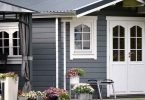
When we first moved, here my gardening eye winced at the sameness of it all. Nothing gave it a sense of place, I could have been anywhere. The builder’s palette of plants was narrow and all the landscapes started out pretty much the same — a couple of trees, a few foundation shrubs, and some flowering ornamentals for interest.
Nearly thirteen hundred homes surround me. Street after street, rows of nearly identical houses stretch out in every direction. Tiny yards encircle each house offering a bit of green relief from the glare of concrete and asphalt. This is my neighborhood. No judging, I like it here.
Over the years my neighbors and I have changed our landscapes. Slowly the monotonous repetition evolved into a more engaging tapestry of different designs and plants, each yard revealing clues about the people inside the house.
I’m happy here and I want my landscape to look like it’s part of the Piedmont of North Carolina, not some faraway place. So I’ve added several native plants to my garden, but rarely do I see them in my neighbors’ landscapes. Walking through my neighborhood, I often ask, “Why did they choose that plant? It looks out of place.”
I am a student in the North Carolina Botanical Garden’s Certificate in Native Plants program. In addition to coursework, students in the program are required to complete a capstone project. I decided exploring my neighbors’ landscape choices would be a good research project for me.
As with any good journey, I didn’t find what I had expected. In fact, after hundreds of hours of interviews, transcription, and analysis I learned things both obvious and unexpected.
The Obvious
My community is age-restricted to people over 55. You can draw your own conclusions about my age, if you dare. One consequence of our older demographic is that we don’t need room for kids to play in our yards; we patter around outside at a reasonable pace. My neighbors and I mostly view our landscapes as a place to sit and relax.
During my research interviews, often my neighbors’ said their motivation for changing their landscape was improving its appearance. How they defined “improve” varies a lot — reducing overcrowded plantings, adding plants to gain privacy, or adding edging to mulch beds were frequent improvement projects.
Nearly 70 percent of the neighbors I interviewed felt that adding color was their top priority to improve their landscape’s appearance. This isn’t surprising given the monochromatic designs the builder installed. Make it colorful, make it pretty — this finding feels unremarkable and about what I expected.
The Unexpected
What I hadn’t accounted for was the passage of time impacting landscape choices. Maybe I would have seen a different outcome with a younger population, maybe it was COVID’s influence, or maybe I just didn’t think it through. However, a majority of my neighbors chose plants for their landscape based on their past. Plants that “I’ve always grown” or plants relatives grew, have a strong pull. Memories of roses grown by mothers, pansies planted in the fall with now long-grown children, or happy family walks among spring flowers motivated my neighbors to make changes to their landscapes.
I have my list of must-have garden residents. But this research project helped me realize that the gladiolus struggling to survive along my walkway might be there because of my memories of glads thriving next to my grandfather’s door. My glads aren’t the right plant for that place, but instead a keeper of my memories, a walkway connecting to my childhood. Armed with this insight, will I keep continue to doom glads to fail in the wrong location? Probably, after all, happy memories are a powerful thing.
If plants help us connect to our memories, perhaps native plants can help frame the uniqueness of here as we make new memories.
For more information about the North Carolina Botanical Garden’s Certificate in Native Plants visit https://ncbg.unc.edu/learn/adult-programs/native-plants.
Want to add more native plants to your landscape? The North Carolina Native Plant Society’s website can help you find the right plant for your place. Visit ncwildflower.org.
Learn about making your landscape more bird-friendly. Visit New Hope Audubon Society’s site for ideas: newhopeaudubon.org.
Featured image by Lise Jenkins.
—
Dr. Lise Jenkins chairs the Master Naturalist Volunteer program for Durham and Chatham County Extension. More at Absentee-Gardener.com.